
Factory Direct vs Trading Company: Cost, Control, and Risk Comparison
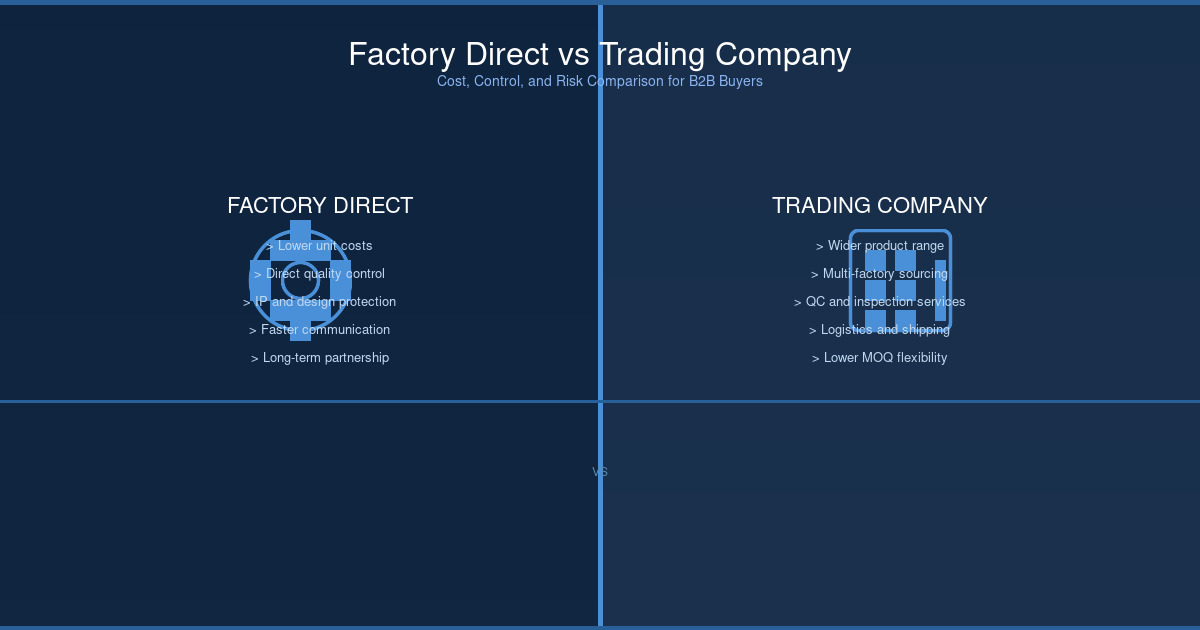
What Factory Direct and Trading Company Actually Mean
A factory-direct relationship means you’re buying straight from the manufacturer that owns the production line, the molds, and the workforce. No intermediary sits between your purchase order and the shop floor. You negotiate pricing directly. You review the BSCI audit report yourself. When something goes wrong on line 3, you hear about it from the production manager.
Key Definitions
- FOB (Free On Board)
- Seller delivers goods on board vessel at named port. Risk transfers to buyer once goods cross ship rail. Standard pricing basis for Chinese manufacturers.
- Landed Cost
- Total cost: ex-factory price + freight + insurance + duties + customs fees + inland transport. Typically 115-130% of FOB for US-bound LED shipments.
- MOQ (Minimum Order Quantity)
- Smallest order factory will accept. Driven by raw material minimums and production setup costs. Higher MOQ typically enables lower per-unit pricing.
- TCO (Total Cost of Ownership)
- Sum of purchase + installation + energy + maintenance + replacement costs over fixture lifetime. LED TCO typically 40-60% lower than conventional lighting.
Standards & References
- Incoterms 2020 — International Chamber of Commerce rules for trade terms.
- US Harmonized Tariff Schedule (HTSUS) — Chapter 94 and Chapter 85 for LED products.
- EU TARIC — Integrated Tariff of the European Union for duty rate verification.
- Industry cost surveys and component supplier datasheets (2024-2026).
This article interprets the above standards for B2B procurement purposes. Refer to original standard documents for full technical details.
A trading company is a sourcing intermediary. They don’t own factories. What they own is supplier relationships, QC infrastructure, and the ability to aggregate orders from multiple buyers to hit MOQs that individual importers can’t reach alone. A good one visits partner factories weekly, maintains inspection staff on the ground, and carries enough volume that factories answer WeChat messages within minutes. A bad one is a PO box with a logo: forward your specs to the lowest bidder, hope the shipment passes inspection. Kingseng, a China-based, lighting-focused B2B sourcing partner, operates with in-house QC engineers, documented AQL standards, and factory relationships built over years, not cold emails.
What neither model is: factory-direct doesn’t mean you’ll get the best price on a 200-unit order. The factory’s real price goes to buyers who fill containers. And a trading company isn’t automatically more expensive. Their aggregate buying power sometimes lands raw material pricing that beats what a single buyer can negotiate. The question isn’t “which is cheaper?” It’s “which is cheaper for my order profile?”
How to Decide: The Four-Question Framework
Answer these four questions. The answer surfaces on its own, no spreadsheet needed.
Question 1: What’s your per-SKU volume? Ordering 1,000+ units of a single SKU per run? Factories want your business. The production manager schedules a clean run without constant changeovers eating margin. Order 200 units across eight SKUs and factories lose interest fast. Setup time kills efficiency, so they ghost your inquiry or quote “go away” pricing at 30-40% above their real rate. Trading companies thrive in multi-SKU, low-volume scenarios. They batch your order with similar ones from other buyers. Your 200 downlights get grouped with someone else’s 300, and the factory sees a 500-unit order worth running.
Question 2: Do you have QC infrastructure in China? Factory direct means the QC burden is entirely yours. Budget $300-$380 per inspection day plus travel. A proper setup covers pre-production inspection, during-production at 30-40% completion, pre-shipment at AQL 2.5/4.0, and container loading supervision. That’s $1,200-$1,500 per production run before you’ve paid for a single unit. If you don’t have this, a trading company absorbs it. A competent one has inspectors visiting partner factories weekly, not once per run.
Question 3: How specialized is your product? Buying standard catalog products like GU10 downlights or basic track fixtures? A trading company sources these from dozens of factories and delivers consistent quality. The supply chain is mature. Developing a custom housing with proprietary heat-sink geometry and a specific driver integration? You need direct factory access. Every feedback round that passes through a trading company rep adds 2-4 days and introduces interpretation risk. On a custom project with NRE/tooling costs of $5,000-$15,000, those delays compound fast.
Question 4: What’s your risk tolerance for after-sales issues? When 300 units arrive with driver failures, the factory-direct buyer emails the production manager. Sometimes they get a fix commitment in hours. Sometimes they’re ghosted; the factory has 40 other buyers and a $25,000 order isn’t a priority. The trading company buyer calls their account manager, who has ongoing factory relationships and influence a single buyer doesn’t. A trading company with 15 clients represents $500K-$2M in annual factory revenue. One buyer at one container a quarter represents $100K-$200K. The math on who gets priority isn’t complicated.
Factory Direct vs Trading Company: By the Numbers
| Dimension | Factory Direct | Trading Company | What It Means for You |
|---|---|---|---|
| Unit Price | Lowest available. No intermediary margin. Expect $0.50-$2.00/unit below trading company quotes on commodity LED products at container volumes. | 5-15% above factory-direct pricing. But aggregate buying can narrow the gap on raw-material-intensive products where bulk purchasing power matters. | Price gap shrinks on small orders where factories inflate MOQ-protection pricing. At 200 units, a trading company may quote lower than a factory. |
| MOQ | High. Most factories want 500-1,000+ units per SKU. Below that, they refuse or quote “nuisance pricing.” | Flexible. Split MOQ across multiple buyers. 50-200 units per SKU is standard. The relationship already exists. | Need 200 units each of 5 SKUs? Factory won’t respond. Trading company quotes in 48 hours. |
| Quality Control | You build and fund QC. Budget $600-$1,000 for third-party PSI plus loading supervision. Factory internal QC unverified until you audit with a factory audit checklist. | QC baked into the relationship. Reputation depends on shipping good product. In-house inspectors, documented AQL 2.5/4.0 standard. | Factory QC is only as good as your last audit. Trading company QC is only as good as their inspection reports. |
| Production Visibility | Full. Walk the production line, review SMT placement, check aging racks, verify components. Direct access to real-time schedules. | Filtered. You see what they share. Factory visits are possible but chaperoned. Production line visibility depends on their transparency practices. | If your product has safety-critical components, direct production line verification isn’t optional. This is why experienced buyers stay factory direct. |
| Customization | Full. New molds, custom drivers, proprietary housings, unique packaging. You pay NRE/tooling ($2,000-$15,000+). Engineering works from your CAD files directly. | Limited to catalog mods. CCT changes, labeling, packaging, yes. Custom PCB layouts or new extrusion dies, no. Factory owns the engineering relationship. | “Differentiated by design” → factory direct. “Differentiated by branding and distribution” → trading company works. |
| Lead Time | 30-60 days production. You manage it all. Factory delays are your problem. No buffer. | 35-65 days. Adds 3-7 days for consolidation, QC, documents. But they absorb and triage factory delays before they reach you. | Predictability beats speed. A reliable 42 days beats an optimistic 30 that stretches to 55. |
| Payment Terms | Standard 30/70 T/T: 30% deposit, 70% before shipment. L/C for orders above $50K. Net terms rare until 5+ orders. | More flexible. Net 30-60 after 3-4 orders. Consolidated payment across factories. L/C acceptance more common. | Net 30 after 3 orders delivers 30-day cash conversion advantage. Real working capital if you’re managing inventory turns. |
| After-Sales | Direct line to factory. Response quality varies from same-day fixes to indefinite silence. Incentive to resolve drops after the 70% balance clears. | Single contact for warranty, replacements, disputes. Business model depends on your repeat orders. Structural incentive alignment. | Factories ghost buyers over $4,000 defect claims. A trading company can’t afford that. |
| Product Range | Deep but narrow. One factory, one category. Need downlights, track lights, and pendants? That’s three relationships, three QC setups, three payment schedules. | Broad, consolidated. One PO, one QC report, one shipment, one invoice across categories. Operational simplicity scales. | Three supplier relationships isn’t 3x the work. It’s closer to 5x from coordination overhead. |
Key Takeaways
- Your order profile picks the model. 1,000+ units per SKU, container volumes, QC partner in China? Factory direct. 200 units across six categories, no boots on the ground? Trading company isn’t a compromise; it’s the operationally correct choice.
- The 5-15% markup buys three things you’d build yourself: QC infrastructure ($1,200-$1,500 per run), MOQ flexibility factories won’t offer small buyers, and after-sales accountability that doesn’t evaporate after payment clears. For most buyers under $500K annual import volume, the trading company markup is cheaper than DIY.
- Production line visibility is the factory-direct trump card. If your product needs UL/ETL certified components, BSCI or ISO 9001 verified environments, or engineering collaboration, the trading company intermediary layer introduces communication risk you shouldn’t accept. But for catalog products from mature supply chains, direct visibility delivers diminishing returns.
- A factory-direct relationship that goes bad is expensive. The 30/70 structure means the factory has 70% of your money before shipping. After that, your bargaining power is gone. Trading companies invest in the ongoing relationship. Calculate the cost of one failed shipment before optimizing for $0.30/unit on the invoice.
Frequently Asked Questions
Q: How do I verify whether a supplier is a real factory or a trading company pretending to be one?
A: Three tests. First, ask for their business license (营业执照). The registered scope tells you everything: factories list 制造 (manufacturing), trading companies list 贸易 (trading). Second, request the BSCI or ISO 9001 audit report. Real factories have these on file; trading companies hesitate. Third, ask for a live video call from the production floor on 24 hours’ notice. If they can’t walk onto a factory floor they supposedly own within a day, you’re talking to a middleman.
Q: Can a trading company ever beat factory pricing?
A: On small orders, yes. Factories use MOQ-protection pricing: 200 units gets quoted 30-40% above the real rate at 1,000 units. A trading company aggregating five buyers at 200 units each negotiates the 1,000-unit price and passes most savings through. For commodity LED panels, the crossover is around 300-500 units per SKU. Above that, factory direct wins on unit price. This isn’t magic. It’s about who reaches the right point on the factory’s volume discount curve.
Q: What’s the biggest factory-direct risk first-time buyers underestimate?
A: After-sales abandonment. Standard 30/70 terms mean the factory has 70% of your money before the container sails. After payment clears, your bargaining power is the promise of future orders. One container a year doesn’t carry weight. Defect claims sit unresolved because fixing them costs more than the factory expects to earn from you. We’ve seen buyers spend $2,800 on lawyers over a $4,200 claim, chasing a factory that stopped responding. For small and mid-size buyers, the after-sales accountability gap is the single most expensive hidden cost of going factory-direct.
Q: Do trading companies handle EXW and FOB shipments the same way factories do?
A: Not quite. Trading companies default to FOB or CIF because logistics is part of their service. EXW from a trading company is unusual and often signals margin-skimming. Factories ship EXW more willingly, but that puts everything on you: Chinese trucking ($200-$400), export clearance ($150-$300), terminal handling ($150-$250). Unless you have a freight forwarder with a China office, EXW is wrong regardless of sourcing model. Start with FOB. It’s the cleanest handoff and easiest to compare across suppliers.
Q: How do I transition from a trading company to factory direct as my volumes grow?
A: Don’t burn the bridge. The trading company that helped you scale holds supplier relationships you can’t replicate quickly. Identify 1-2 SKUs at factory-attractive volumes. Approach factories directly for those SKUs, keeping the rest with the trading company. Run a parallel trial: small factory-direct order alongside normal volume. Compare unit price, defect rates, and resolution speed across two cycles. Most buyers discover factory direct works for their top 3 SKUs; a trading company is still the rational choice for the long-tail 20.
Frequently Asked Questions
Q: How can I verify if a supplier is actually a factory and not a trading company posing as one?
A: Three concrete checks separate real factories from trading companies. First, pull their business license from China’s National Enterprise Credit Information Publicity System. The “business scope” field tells the truth: factories list manufacturing activities while trading companies list wholesale and trading. Second, request their most recent BSCI or ISO 9001 audit report with the issuing body’s name and certificate number. Real factories undergo annual audits and have these on file; trading companies stall or send generic documents. Third, ask for a live video walkthrough of the production floor with less than 24 hours notice. A genuine factory can accommodate this because the line is already running. A trading company will push back, offer a showroom tour instead, or claim “security concerns.” If a supplier fails any one of these three tests, treat them as a trading company regardless of what their website says.
Q: When does using a trading company make more practical sense than buying factory direct?
A: Three scenarios tilt the decision toward a trading company. Scenario one: you are sourcing across 3 or more product categories and do not have the team bandwidth to manage separate factory relationships, QC protocols, payment schedules, and logistics for each. One point of contact covering all categories is operationally cheaper than hiring a China-based sourcing team. Scenario two: your per-SKU order quantity is below 500 units. Most factories will either refuse outright or quote pricing 30 to 40 percent above their real rate at 1,000 units, erasing any direct-buy advantage. Trading companies aggregate small orders from multiple buyers to hit factory-friendly volumes. Scenario three: your product is a standard catalog item from a mature supply chain. GU10 downlights, basic track heads, and commodity LED panels do not benefit from direct production-line access. A trading company with established supplier relationships ships them at competitive landed cost with less management overhead on your side.
Q: What is the real cost difference between factory direct and trading company sourcing for LED products?
A: On a per-unit basis, factory direct pricing is typically 15 to 25 percent below trading company quotes for identical specifications at container volumes of 1,000 units or more. For a $12.00 factory-direct downlight, the trading company equivalent runs $13.80 to $15.00. But unit price comparisons miss the full picture. The factory-direct buyer absorbs QC costs of $600 to $1,200 per production run for third-party inspection, plus the time cost of managing supplier communications across time zones. The trading company buyer pays a higher unit price but offloads those costs. The crossover point where factory direct delivers better total landed cost is roughly $50,000 in annual procurement spend per product category. Below that threshold, the trading company’s operational efficiency and built-in QC usually outweigh the per-unit price gap. Run the math on your specific order profile: multiply your annual unit volume by the 15 to 25 percent gap, then subtract your real cost of QC inspections, factory visits, and internal sourcing staff time.
Q: What are the biggest risks of factory-direct sourcing that first-time importers underestimate?
A: The number one risk is after-sales abandonment. Under standard 30/70 T/T payment terms, the factory holds 70 percent of your money before the container leaves China. Once that payment clears, your bargaining power is the promise of future orders. If you are ordering one container per quarter, that promise carries weight. If you are ordering one container per year, it does not. We have seen importers spend $2,800 on legal fees chasing a $4,200 defect claim against a factory that simply stopped replying to emails. The second major risk is production priority: factories schedule their largest and longest-standing customers first. A 500-unit trial order from a new buyer goes to the back of the production queue every time a regular customer with a 10,000-unit order calls. That 30-day lead time becomes 55 days and your retail shelf sits empty. The third risk is communication failure on technical specifications. Factory sales teams often speak functional “price and MOQ” English but struggle with detailed tolerance discussions, material substitution questions, and certification requirements. When these get lost in translation, you own the defective product with no intermediary to absorb the cost.
Q: How do MOQ requirements differ between factories and trading companies?
A: Factories typically set MOQs at 500 to 1,000 units per SKU for standard LED products. Below that threshold, they either refuse the order outright or quote “go away” pricing at 30 to 40 percent above real rates to make it worth their while. The reasoning is straightforward: SMT line changeover costs the same whether they run 100 boards or 1,000, so small runs destroy margin. Trading companies operate differently: because they aggregate orders from multiple buyers, they can accept MOQs as low as 50 to 200 units per SKU. Your 200 downlights get consolidated with three other buyers’ orders into a single 800-unit production batch that makes economic sense for the factory. For multi-SKU sourcing, the difference is even starker. Ordering 200 units each of 6 SKUs direct from factories means finding and managing 6 separate suppliers, each quoting protective pricing on sub-MOQ volumes. A trading company handles all 6 SKUs on a single purchase order, single QC report, single invoice, and single consolidated shipment. For importers spending under $100,000 annually across multiple product lines, the trading company’s MOQ flexibility alone often justifies their markup.