
Sourcing Lighting Fixtures from Longgang, Shenzhen: A Buyer’s Local Supply Chain Map (B2B 2026)
Sourcing Lighting Fixtures from Longgang, Shenzhen: A Buyer’s Local Supply Chain Map (B2B 2026)
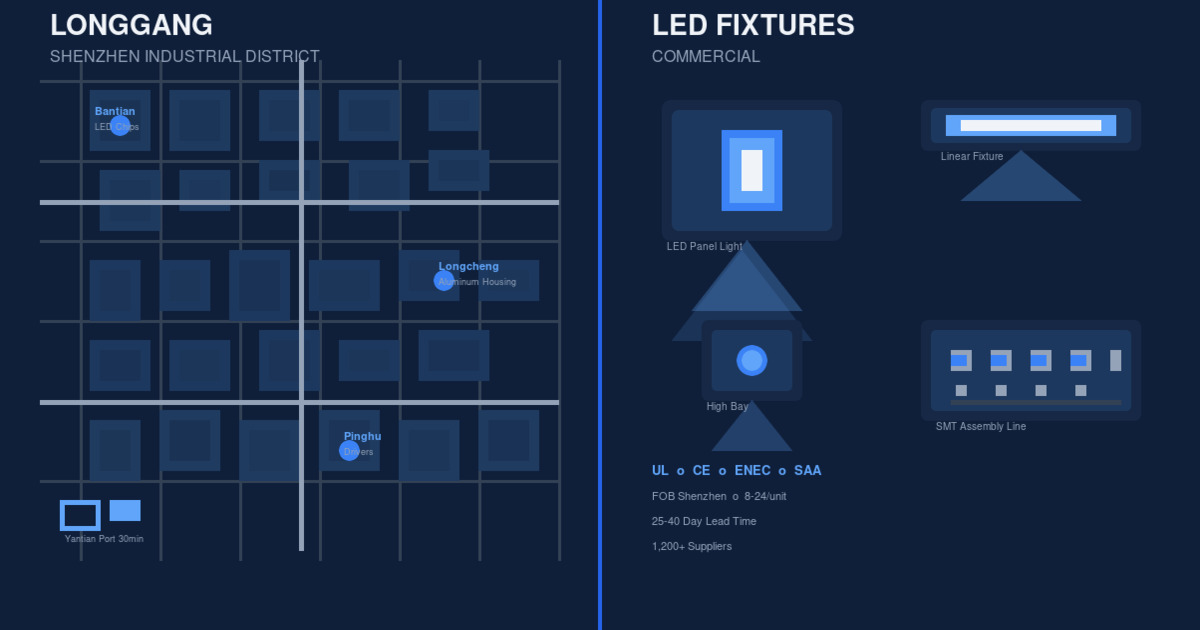
Direct Answer: Longgang district in northeast Shenzhen packs roughly 1,200+ lighting-related companies across three specialized subdistricts: Bantian (LED chips and SMD packaging), Pinghu (drivers and logistics), and Longcheng (aluminum housings). Buyers can go from component sourcing to finished UL/CE-certified fixtures in 25–40 days, faster than Zhongshan for electronics-heavy products. Yantian port is 30–45 minutes by truck, and the district has four major bonded warehouse zones for consolidation. If you need fixtures with complex drivers, smart controls, and FOB pricing in the $12–$48 range, start in Longgang.
Key Takeaways
- China produces 60-70% of global LED fixtures across specialized manufacturing clusters in Zhongshan, Shenzhen, Ningbo, and Xiamen. Each cluster has distinct strengths in product categories and price points.
- Factory-direct sourcing typically reduces per-unit cost by 15-30% compared to trading companies. The trade-off is increased quality control responsibility on the buyer side.
- Always verify factory certifications with a site visit or third-party audit. Certificates on an office wall without current test reports from accredited labs are insufficient.
- Build 30-45 days of buffer into your first-order timeline. Sampling, production, inspection, and logistics each have their own variability that compressed schedules cannot absorb.
Key Definitions
- Lumen Output (lm)
- Total visible light emitted. More meaningful than wattage for brightness comparison. Always verify via IES LM-79 test report, not manufacturer claims.
- CRI (Color Rendering Index)
- 0-100 scale measuring color accuracy. CRI ≥80 for general commercial; CRI ≥90 for retail and healthcare. Check R9 (red) value separately.
- IP Rating (Ingress Protection)
- Two-digit code per IEC 60529. First digit: solid protection (0-6). Second: liquid protection (0-9). IP65 = dust-tight + water jets. IP20 = indoor only.
- Efficacy (lm/W)
- Lumens per watt. Commercial LED fixtures achieve 100-150 lm/W. System efficacy is lower than LED package efficacy due to driver and optical losses.
Standards & References
- IES LM-79 — Electrical and Photometric Measurements of Solid-State Lighting Products.
- IES LM-80 — Measuring Lumen Maintenance of LED Light Sources.
- IES TM-21 — Projecting Long-Term Lumen Maintenance of LED Light Sources.
- IEC 60598 — Luminaires — Part 1: General requirements and tests.
- EN 12464-1 — Light and lighting — Lighting of work places — Indoor work places.
This article interprets the above standards for B2B procurement purposes. Refer to original standard documents for full technical details.
1. Why Longgang Matters for LED Buyers in 2026
Most sourcing pros know Zhongshan’s Guzhen as “the lighting capital” for decorative residential. But for commercial troffers, linear office fixtures, high-bay LEDs, or anything with DALI/0-10V dimming and IoT controls, Longgang is the smarter play. The district’s manufacturing grew from Shenzhen’s electronics ecosystem. PCB fabs, IC houses, and driver engineers all sit within a 20-minute radius. That integration doesn’t happen in Zhongshan.
Longgang covers 388 sq km of industrial and mixed-use zones; not one lighting town but specialized sub-clusters forming a complete supply chain. Shenzhen’s LED output exceeded $32B in 2024; Longgang contributed 18–22%, concentrated in commercial and industrial fixtures. For 40-foot containers, inland trucking to Yantian costs ¥1,800–¥2,400 ($250–$330) versus ¥4,500+ from Zhongshan.
2. The Component Cluster Map: Who’s Where
Bantian (坂田): LED Chips, SMD Packaging, and PCBs
Bantian is the electronics brain: 300+ companies doing LED chip distribution, SMD packaging, and multilayer PCB fabrication. NationStar and Refond have packaging facilities within 5 km of Bantian metro station. Nichia 757 and Seoul Semiconductor mid-power LED distributors operate right here. Custom SMD strip turnaround: 7–10 days at 5,000-meter MOQs.
PCB shops run 2–4 layer aluminum-core boards (1.6mm, 2.0W/mK) with ENIG or HASL finishes at 4–6 day lead times for prototypes. Production volumes of 10,000+ units use CEM-1 and FR-4 from the same cluster, so assembly factories aren’t waiting on Huizhou or Dongguan shipments.
Pinghu (平湖): Drivers, Power Supplies, and Logistics
Over 200 driver manufacturers in Pinghu produce constant-current and constant-voltage units from 3W to 600W. Mean Well distributes here, but the real players are local: Eaglerise, Sosen, and Lifud all run engineering and production within Pinghu. They offer UL Class 2, ENEC, and SAA-certified drivers at 4–6 week custom lead times. MOQs run 500–1,000 units; engineering fees range $1,500–$4,000.
Pinghu Logistics Park spans 2.6 million square meters and houses eight major bonded warehouse operators. It’s 22 km from Yantian port (35 minutes by container truck outside peak). Consolidation services combine Bantian components and Longcheng housings into single FCL loads, saving $400–$700 per shipment.
Longcheng (龙城): Aluminum Housings and Extrusion
Longcheng and adjacent Longdong host 150+ aluminum extrusion and die-casting shops specializing in lighting housings: linear fixtures, troffer frames, high-bay heatsinks. Standard 6063-T5 extrusions with anodized or powder-coated finishes are standard. Lead times: 10–15 days for stock profiles, 18–25 days for custom dies and first articles.
A 1200mm x 300mm troffer housing with anodized finish runs ¥38–¥55 ($5.20–$7.60) at 1,000-unit quantities. Ningbo equivalents come in 12–18% higher after inland freight. These shops also handle CNC drilling, tapping, and assembly-ready packing.
3. Assembly Factories vs. Component Specialists
The Longgang supply chain splits roughly 60/40 between component specialists and full-assembly factories. Component guys focus on one category (drivers, housings, or LED modules) at scale. Assembly factories (80–300 workers) source locally, handle SMT placement, wiring, final assembly, aging tests, and packaging.
Foreign buyers do best with a Tier-2 assembly factory that has relationships across all three subdistricts. These factories run 2–4 assembly lines, turn a 40-foot container (8,000–12,000 units) in 25–35 days, and carry ISO 9001:2015. They quote FOB Shenzhen. A 60W 600x600mm LED panel with flicker-free driver and 5-year warranty lands at $18–$24 at 1,000-unit quantities: 10–15% below equivalent Ningbo quality and roughly in line with Zhongshan, but with better electronics integration.
Watch out: component specialists sell directly, but unless you’re ordering 50,000+ units with on-the-ground QC, the coordination overhead eats any component-level savings.
4. Planning Your Sourcing Trip
Here’s a 3–4 day itinerary flying into Shenzhen Bao’an International (SZX):
Day 1, Bantian: Stay near Bantian metro (Line 5). The Crowne Plaza Shenzhen Longgang is the buyer default: ¥680–¥950/night, English staff, 15 min to industrial zones. Visit 2–3 LED component and PCB suppliers in the morning, a driver integrator in the afternoon. Factory visit windows: 9:00–11:30 and 14:00–16:30.
Day 2, Longcheng/Longdong: Relocate to Longcheng (Marriott and Hilton properties in the CBD). Morning: two extrusion shops. Afternoon: 1–2 assembly factories. Bring drawings and samples; shops quote on the spot with matching dies.
Day 3, Pinghu + Logistics: Morning: driver manufacturers (book ahead; the good ones are busy). Afternoon: bonded warehouse tour at Pinghu Logistics Park to see consolidation firsthand.
Day 4: Second visits, negotiations, or sample pickup. Skip it if you’re tight on time.
Transport: Didi works everywhere. Budget ¥150–¥300/day. Factory-to-factory: 15–25 minutes. Avoid 8:00–9:00 and 17:30–18:30; rush hour doubles drive times.
5. District Comparison Table
| Factor | Longgang, Shenzhen | Bao’an, Shenzhen | Zhongshan (Guzhen) | Ningbo, Zhejiang |
|---|---|---|---|---|
| Best For | Commercial/industrial fixtures with complex electronics | Consumer LED bulbs, strip lights, small gadgets | Decorative residential, chandeliers, basic downlights | Outdoor/industrial high-bay, floodlights, street lights |
| Driver/Electronics Integration | Excellent: in-district driver cluster with custom engineering | Good: proximity to Shenzhen electronics but less specialized | Moderate: most drivers sourced from Shenzhen or Dongguan | Good: strong outdoor-rated drivers, less on smart controls |
| Port Proximity & Trucking Cost | Yantian: 30–45 min, ~$250–$330/40′ container | Shekou: 25–40 min, ~$220–$300/40′ container | Nansha/Yantian: 90–120 min, ~$620–$750/40′ container | Ningbo-Zhoushan: 45–60 min, ~$280–$380/40′ container |
| FOB Price (60W Panel, 1000 pcs) | $18–$24 | $17–$23 | $16–$22 | $20–$28 |
| MOQ Flexibility | Moderate: 500–1,000 units custom, 200 stock | High: 100–300 unit trial orders | Very high: 50–100 units for stock designs | Low: typically 1,000+ factory-direct |
| Certification Readiness | Strong: UL/ETL/ENEC/SAA experience is standard | Moderate: CE/RoHS common, UL less so | Moderate: CE-heavy, growing UL capability | Strong: CB/ENEC/SAA for export-focused shops |
| Supply Chain Speed | 25–40 days: components within 20 km | 28–42 days: some components from Dongguan | 30–50 days: drivers/PCBs often shipped in | 35–50 days: slower local supply chain |
6. Supply Chain Timeline: Component to Container
A realistic timeline for 5,000 units of 60W LED panels, deposit paid and specs locked:
- Week 1 (Days 1–7): Aluminum housing extrusion and anodizing (Longcheng). PCB fabrication begins (Bantian). Driver BOM confirmed, procurement starts (Pinghu).
- Week 2 (Days 8–14): SMD LED packaging completed (Bantian). PCBs finished and electrically tested. Housing finishing wraps; QC on anodizing color consistency.
- Week 3 (Days 15–21): SMT placement and reflow at assembly factory. Drivers from Pinghu, housings from Longcheng. First-article assembly and photometric testing. In-line QC on-site by Day 18.
- Week 4 (Days 22–28): Full production run. 48-hour burn-in/aging. Final QC: integrating sphere, flicker, packaging inspection.
- Week 5 (Days 29–35): Palletizing, container loading at Pinghu consolidation. Customs docs (Form A, fumigation cert for wood pallets). Truck to Yantian: 35 minutes. Vessel cutoff typically 48 hours pre-sailing.
Total: 29–35 days PO to container departure. Rush orders with pre-stocked components hit 22–25 days at an 8–12% premium. The advantage over Zhongshan is the first two weeks: when PCB fab, SMD packager, and housing shop are all within a 20-minute courier radius, parallel processing actually works.
7. Quality Pitfalls and Supplier Qualification
Longgang’s speed comes with traps. Here’s what to watch for and how to qualify suppliers:
Driver-to-LED matching: A Pinghu driver supplier and Bantian LED module supplier being neighbors doesn’t mean their specs talk. Always test the exact combo in an integrating sphere before production. I’ve seen 8–14% lumen depreciation from mismatched constant-current ranges that looked fine on paper. Budget one extra week and ¥3,000–¥5,000 ($410–$690) for third-party photometric testing at TUV Rheinland’s Nanshan lab.
Anodizing batch consistency: Color shift between batches is the #1 cosmetic complaint. Specify Delta E ≤1.5 in your PO and require swatch approval from each batch before assembly.
The “we can do UL” problem: Get the UL file number and verify it on UL’s Product iQ database. What often exists is a UL-recognized component inside an unlisted fixture. A proper UL 1598 listing for the complete luminaire adds $3,000–$8,000 and 6–10 weeks if the factory hasn’t done it.
Before you book a flight, do four things:
- Check Qichacha (企查查) or Tianyancha (天眼查): Registered capital above ¥1 million, incorporated 3+ years, zero business anomaly flags. Five minutes and you’ll eliminate 30% of factories that look legit on Alibaba.
- Request a factory audit report: Sedex SMETA 4-pillar or BSCI within 12 months. Stalling or “between audits” is your answer.
- Get 3 reference buyers in your category: Buyers who ordered similar fixtures in the last 6 months, container quantities. Email them about on-time delivery, defect rates, and claim handling.
- WeChat video walk-through: Look for an integrating sphere, an aging rack with fixtures actually running, and SMT lines operating. A factory refusing a 5-minute video tour is hiding something, usually capacity.
For more on vetting suppliers, see our China Supplier Verification Checklist. Comparing Longgang against other clusters? Our Zhongshan Guzhen Lighting Sourcing Guide breaks down when Guzhen makes more sense for your product mix.
Frequently Asked Questions
Q: What’s the minimum order quantity for custom LED fixtures from Longgang?
Assembly factories set MOQ at 500–1,000 units for custom designs needing new tooling (housing dies, custom PCBs). For stock designs with your branding (OEM), MOQs drop to 200–300 units. Custom driver specs typically need 1,000+ units to waive the $1,500–$4,000 NRE fee.
Q: How do Longgang prices compare to Alibaba listings?
Factory-direct FOB for a 60W LED panel (flicker-free driver, 5-year warranty, 1,000 units) runs $18–$24. Alibaba “comparable” panels at $12–$17 usually reflect lower-spec drivers (no UL, higher ripple, shorter warranty) or bait pricing from trading companies that add 15–25% in conversation. Real factory pricing comes from spec sheets and negotiation, not catalogs.
Q: Can I visit Longgang factories without a Mandarin speaker?
You can, but don’t. About 60% of factory managers speak functional English for commercial talks. But production floor leads, QC supervisors, and technical staff speak almost exclusively Mandarin. Hire a technical translator: ¥1,200–¥2,000 ($165–$275)/day for someone who knows LED terminology, not just business Mandarin.
Q: What certifications should Longgang factories already hold?
Export-ready baseline: ISO 9001:2015, CE (EMC + LVD), RoHS 2.0. Better factories add UL 1598 or ETL listings for standard lines, BSCI or Sedex audits, and IEC 62471 photobiological safety testing. A factory with none of these and no timeline to get them is domestic-market-only, regardless of their Alibaba page.
Q: Should I use a sourcing agent or go direct in Longgang?
Below $200,000/year across fewer than 3 SKUs, a Shenzhen sourcing agent earns their 5–8% commission. They handle supplier ID, negotiation, QC, and consolidation, catching the supplier-switching and spec drift common on first orders. Above $500,000/year with 5+ SKUs, an in-house QC inspector (¥12,000–¥18,000/month or $1,650–$2,480) delivers better ROI. See our guide on hiring China-based QC staff for full cost breakdown.
Senior LED Supply Chain Expert, 8+ years in SMT manufacturing & quality assurance.
Verified July 2026 by Kingseng QA Laboratory.
📧 simon@ksimpexp.com