
The Real Cost of Importing from China: Full Breakdown (2026)
\\n\\n
\\n\\n
What “Cost of Importing from China” Actually Means
\\n\\n
When procurement managers talk about import costs, they’re almost always referring to landed cost, which is the all-in price of getting goods from a Chinese factory floor to your warehouse shelf. The invoice price from the supplier is just the starting point. At Kingseng, we’ve watched buyers make the mistake of comparing supplier quotes without accounting for the downstream costs, and that $0.50/unit savings on FOB price evaporates the moment they realize the cheaper supplier’s port is 400 km further inland with worse container availability.
Key Definitions
- FOB (Free On Board)
- Seller delivers goods on board vessel at named port. Risk transfers to buyer once goods cross ship rail. Standard pricing basis for Chinese manufacturers.
- Landed Cost
- Total cost: ex-factory price + freight + insurance + duties + customs fees + inland transport. Typically 115-130% of FOB for US-bound LED shipments.
- MOQ (Minimum Order Quantity)
- Smallest order factory will accept. Driven by raw material minimums and production setup costs. Higher MOQ typically enables lower per-unit pricing.
- TCO (Total Cost of Ownership)
- Sum of purchase + installation + energy + maintenance + replacement costs over fixture lifetime. LED TCO typically 40-60% lower than conventional lighting.
Standards & References
- Incoterms 2020 — International Chamber of Commerce rules for trade terms.
- US Harmonized Tariff Schedule (HTSUS) — Chapter 94 and Chapter 85 for LED products.
- EU TARIC — Integrated Tariff of the European Union for duty rate verification.
- Industry cost surveys and component supplier datasheets (2024-2026).
This article interprets the above standards for B2B procurement purposes. Refer to original standard documents for full technical details.
\\n\\n
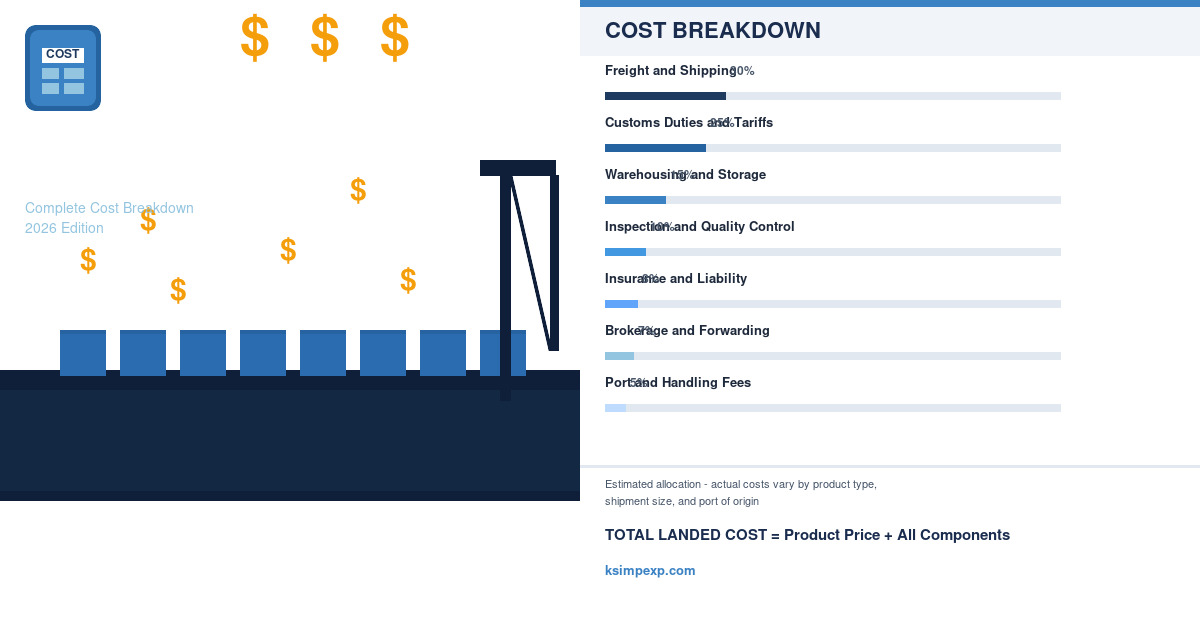
Landed cost breaks into three buckets: pre-shipment costs (product, tooling, samples, QC), freight and logistics (ocean/air freight, insurance, port handling), and post-arrival costs (customs duties, bonds, drayage, warehousing). Skip any bucket in your budget and you’ll find yourself scrambling for cash when your container is sitting at the Port of Long Beach racking up $185/day in demurrage fees.
\\n\\n
Here’s what most guides won’t tell you: the gap between your spreadsheet projection and your actual wire transfers is caused not by the big line items you planned for, but by the small ones you didn’t know existed. Customs exams, ISF filing penalties, chassis rental splits, pier pass fees. These are the line items that turn a profitable import run into a break-even exercise.
\\n\\n
How to Calculate Your Real Import Costs: 5-Phase Process
\\n\\n
Phase 1: Lock in your FOB price. Get quotes from at least 3 suppliers. Make sure each quote uses the same Incoterm (FOB, same port) so you’re comparing apples to apples. Ask for the HS code at this stage. It determines your entire duty calculation downstream. If the supplier won’t share the HS code before you place an order, that’s a red flag.
\\n\\n
Phase 2: Route the freight math. Send the shipment details (CBM, weight, port pairs, preferred sailing window) to 2-3 freight forwarders. Get quotes for both FCL and LCL if your volume is under 15 CBM. Ask specifically about the free days at destination for demurrage and per diem. Don’t just compare the ocean freight line. Ask for the all-in quote including THC, documentation fees, and destination charges.
\\n\\n
Phase 3: Calculate duties and tariffs. Plug the HS code into the USITC HTS lookup at hts.usitc.gov. Note the general duty rate. Then cross-reference against the USTR Section 301 exclusion list for your code. Multiply your FOB value by the total duty percentage (general + 301, if applicable). This number is non-negotiable and you can’t recover it later unless you qualify for duty drawback.
\\n\\n
Phase 4: Add the port-layer and inland costs. Map out every charge between the vessel arrival and your warehouse receiving dock: terminal handling, pier pass (LA/LB), chassis rental, drayage, warehouse unloading. Budget $900-$1,400 for a standard container through a major port. Add $500-$800 extra if you’re going through LA/LB during August-October peak.
\\n\\n
Phase 5: Layer in QC and payment costs. Add $600-$1,000 for a pre-shipment inspection plus container loading supervision. Add $80-$160 for wire transfer fees (two wires: deposit and balance). If using an L/C, add $500-$900 in bank issuance and handling fees. If paying through a traditional bank, factor in a 2-4% FX spread on the total payment. Or switch to a specialist FX provider and cut that to under 1%.
\\n\\n
Product Cost vs Landed Cost: The $15,000 Gap
\\n\\n
Imagine you negotiate a product at $6.25/unit FOB Shanghai. You order 6,000 units. That’s $37,500 on the supplier’s proforma invoice. Nice round number, easy to budget. But by the time those 6,000 units sit in your New Jersey warehouse, your actual outlay will be closer to $52,000. That $14,500 gap isn’t markup. It’s the cumulative weight of freight, duties, inspections, and logistics fees that every importer pays.
\\n\\n
The landed cost formula looks like this:
\\n\\n
\\nLanded Cost = FOB Price + Ocean Freight + Insurance + Customs Duties + Customs Bond + Port Fees + Drayage + Warehousing + QC Costs + Payment Fees\\n For more on this topic, read our guide: Real Cost of Importing from China (Full Breakdown 2026).
\\n\\n
Run that calculation before you negotiate with suppliers. I’ve seen a procurement director at a mid-size lighting distributor reverse-engineer his maximum FOB price from his retail price point. He worked backward from what his customers would pay, subtracted his margin, subtracted all-in landed costs, and arrived at a hard ceiling for the supplier. That’s how you negotiate from strength, not hope.
\\n\\n
FOB, CIF, and DDP: Which Cost Model You Should Use
\\n\\n
Chinese suppliers will quote you in one of three Incoterms, and your choice here determines how much cost risk you carry versus how much control you keep.
\\n\\n
FOB (Free on Board): The supplier covers everything up to loading the container on the vessel at the origin port. You own the freight, insurance, and everything after. Most experienced buyers prefer FOB because you control the forwarder, you pick the sailing schedule, and you avoid the “supplier’s cousin’s freight company” problem. Cost: you need a freight forwarder relationship.
\\n\\n
CIF (Cost, Insurance, Freight): The supplier arranges and pays for freight and insurance to the destination port. Convenient, but you lose visibility. The supplier picks the cheapest routing, which might mean a 45-day transit with two transshipments instead of a 16-day direct sailing. And if the container gets rolled (bumped to a later vessel because the ship is full), you won’t know until your forwarder never receives the arrival notice.
\\n\\n
DDP (Delivered Duty Paid): The supplier handles everything door-to-door, including import duties. Sounds perfect. It’s also the most expensive. Suppliers build a 15-25% risk buffer into DDP quotes. Use DDP for small trial orders under $5,000 where the convenience is worth the premium. For anything that fills a pallet or more, switch to FOB and manage the logistics yourself.
\\n\\n
| Incoterm | Supplier Pays | You Pay | Best For | Typical Premium |
|---|---|---|---|---|
| FOB | Factory to vessel loading | Freight, insurance, duties, delivery | Regular importers, orders over $5K | Baseline |
| CIF | Factory to destination port | Duties, customs, inland delivery | First-time buyers, simple shipments | +8-15% over FOB |
| DDP | Everything door-to-door | Nothing (built into price) | Samples, trial orders under $5K | +20-35% over FOB |
\\n\\n
Freight Costs: Ocean vs Air, LCL vs FCL
\\n\\n
Ocean freight is the backbone of China imports. For a 40ft container from Shanghai to Los Angeles in mid-2026, expect to pay $2,800-$4,200 depending on the carrier, sailing frequency, and whether you book 2 weeks or 2 days before departure. Spot rates spike during peak season (August-October) and around Chinese New Year (January-February). If you can commit to quarterly volumes, lock in a contract rate and you’ll save 15-20% versus spot.
\\n\\n
FCL (Full Container Load): You book an entire container. A 20ft holds roughly 28 CBM (10 standard pallets) and a 40ft holds about 58 CBM (20-22 pallets). Cost per unit drops dramatically when the container is full. If your shipment is 15 CBM or larger, FCL is almost always cheaper than LCL on a per-unit basis.
\\n\\n
LCL (Less than Container Load): You share container space with other importers’ cargo. Works for shipments under 10 CBM. The catch: LCL adds consolidation and deconsolidation fees at both ends, and your goods get handled 6-8 more times than in an FCL shipment. More handling equals more damage risk. For shipments between 10-15 CBM, run both LCL and 20ft FCL quotes. The crossover point varies by route.
\\n\\n
Air freight: For urgent shipments under 500 kg. Rates run $4.50-$7.80/kg from major Chinese airports to US hubs. Transit is 3-7 days door-to-door versus 25-35 days for ocean. Use air freight for samples, replacement parts for defective shipments, or seasonal goods that missed the ocean deadline. Never use it for regular production orders. The cost premium is 8-12x ocean. For more on this topic, read our guide: The Real Cost of LED Lighting: Factory-Direct Sourcing from China.
\\n\\n
| Freight Method | Cost Range (2026) | Transit Time | Best Fit |
|---|---|---|---|
| 20ft FCL Ocean | $1,800-$2,800 | 22-32 days | 10-28 CBM shipments |
| 40ft FCL Ocean | $2,800-$4,200 | 22-32 days | 30-58 CBM shipments |
| LCL Ocean | $120-$200/CBM | 28-38 days | Under 10 CBM |
| Air Freight | $4.50-$7.80/kg | 3-7 days | Under 500 kg, urgent |
\\n\\n
US Customs Duties and Section 301 Tariffs
\\n\\n
Every product entering the US gets classified under an HTS code, and that code determines your duty rate. Most consumer goods fall between 0% and 8% duty. Electronics are often duty-free. Textiles and apparel can hit 12-20%. But the real wildcard since 2018 has been Section 301 tariffs on Chinese-origin goods.
\\n\\n
As of 2026, Section 301 tariffs remain in place on roughly $300 billion worth of Chinese imports across Lists 1-4A. Rates vary by product category: some electronics components face 7.5%, many consumer goods sit at 25%, and certain medical supplies and PPE are excluded entirely. You can’t guess this. Run every HS code through the USITC database and check the current 301 exclusion list before you issue a purchase order. A lighting importer I know discovered mid-shipment that his decorative fixtures carried a 25% 301 tariff he hadn’t budgeted for. That was a $6,200 surprise on a $25,000 order.
\\n\\n
Duty drawback is worth knowing about: if you import goods, then re-export them (or destroy them under customs supervision), you can recover 99% of the duties paid. Not relevant for most importers, but if you run a distribution model serving both US and Latin American markets, it’s money on the table.
\\n\\n
Customs Bonds, Port Fees, and the Charges Nobody Quotes Upfront
\\n\\n
A customs bond is mandatory for any import valued over $2,500. You have two choices: a single-entry bond (costs roughly $50-$100 per shipment, covers one entry) or a continuous bond (costs roughly $500-$700/year, covers unlimited entries up to a coverage limit, typically $50,000 or $100,000). If you import more than 3 times a year, the continuous bond pays for itself by the fourth shipment.
\\n\\n
Then come the port and terminal charges that first-time importers never see coming:
\\n\\n
- \\n
- Terminal Handling Charge (THC): $200-$400 per container at the destination port
- Pier Pass / Traffic Mitigation Fee: $35-$75 per container at LA/LB ports
- Chassis Rental: $25-$45/day if you don’t return the chassis within the free window
- Demurrage: $150-$250/day when your container sits at the terminal past the free days (typically 4-5 free days)
- Per Diem: $125-$200/day when you keep the container past the free days after picking it up
- Customs Exam (tailgate or intensive): $350-$1,500+ if CBP flags your container for inspection
- ISF Filing: $35-$75 per filing (mandatory, due 24 hours before vessel departure)
\\n
\\n
\\n
\\n
\\n
\\n
\\n
\\n\\n
Demurrage is the killer. One client’s container arrived on a Thursday afternoon before a holiday weekend. The trucker couldn’t get an appointment until Tuesday. Four days of demurrage at $195/day. That’s $780 gone, on top of the $450 chassis surcharge for the same delay. Budget a minimum of $900-$1,400 per container for these miscellaneous port-layer fees, and double that if you’re importing through LA/LB during peak season when appointments are scarce.
\\n\\n
Quality Control Costs: Inspections, Testing, and the Price of Not Checking
\\n\\n
Quality control isn’t optional. It’s a cost line item that prevents far larger costs downstream. Standard QC services for China imports:
\\n\\n
- \\n
- Pre-Production Inspection: $280-$350/day. Verifies raw materials and components before production starts. Worth it for custom-manufactured goods.
- During-Production Inspection (DPI / DUPRO): $300-$380/day. Checks product quality at 20-40% production completion. Catches issues early enough to fix them without scrapping finished goods.
- Pre-Shipment Inspection (PSI): $300-$380/day. The must-have. Inspects finished goods at 80-100% completion. Uses AQL sampling (typically AQL 2.5 for major defects, AQL 4.0 for minor). Every shipment should get a PSI.
- Container Loading Supervision (CLS): $300-$350/container. Verifies quantities loaded, packaging condition, and container seal. Prevents the “we shipped 2,000 units” / “we received 1,850” dispute.
- Lab Testing: $150-$800 per test depending on standard. UL certification testing runs $3,000-$8,000. Factor this into your first-order budget.
\\n
\\n
\\n
\\n
\\n
\\n\\n
For a typical 40ft container import, budget $600-$1,000 for QC. That covers a single PSI plus container loading supervision. Skip this and you’re gambling $30,000-$50,000 worth of goods on a supplier’s internal QC process, which is exactly what the supplier’s other 40 customers are doing. The ones who get priority on rework when problems surface are the ones paying for third-party inspection.
\\n\\n
Payment Method Costs: Wire Transfers, L/Cs, and the Hidden FX Spread
\\n\\n
How you pay your supplier affects your total cost more than most buyers realize. For more on this topic, read our guide: B2B LED Lighting Buyer’s Guide: 15 Critical Questions.
\\n\\n
T/T (Telegraphic Transfer / Wire): Standard structure is 30% deposit to start production, 70% balance before shipment (against copy of B/L). Bank fees run $25-$55 per wire for domestic US banks, $45-$80 for international wires through intermediary banks. The real hidden cost is the FX spread. Most banks add 2-4% to the mid-market rate on USD-to-CNH conversions. On a $50,000 payment, that’s $1,000-$2,000 in hidden FX margin. Use a specialist FX provider (Wise Business, OFX, Airwallex) instead of your bank and spreads drop to 0.4-0.8%.
\\n\\n
L/C (Letter of Credit): Irrevocable L/C at sight costs 0.5-1.5% of the transaction value in bank issuance fees, plus amendment fees ($75-$150 per change) and discrepancy fees ($75-$125 per document discrepancy). An L/C on a $50,000 purchase will cost $500-$900 in bank fees. Use L/Cs for first orders with new suppliers or orders above $75,000 where the payment security justifies the cost. For repeat orders with trusted suppliers, T/T is cheaper and faster.
\\n\\n
Supplier payment terms: The standard in China is 30/70 T/T. Some suppliers offer 30% deposit, 70% net 30-60 days after B/L date if you have an established relationship. Negotiate for this on your third or fourth order. It improves your cash conversion cycle by 30-45 days.
\\n\\n
Sample Cost Breakdown: 40ft Container, $25,000 FOB Shanghai to Chicago
\\n\\n
| Cost Line Item | Low Estimate | High Estimate | Notes |
|---|---|---|---|
| FOB Product Cost | $25,000 | $25,000 | Negotiated with supplier |
| Ocean Freight (40ft, SHA to LAX) | $2,800 | $4,200 | Varies by season/carrier |
| Marine Insurance (0.3% of CIF) | $85 | $130 | Coverage for total loss/damage |
| US Customs Duty (estimated 5.5%) | $1,375 | $1,375 | At FOB value for duty calc |
| Section 301 Tariff (if applicable @ 25%) | $0 | $6,250 | Product-dependent; verify HS code |
| Customs Bond (single entry) | $65 | $100 | Continuous bond: prorate ~$50/entry |
| ISF Filing | $35 | $75 | One-time per shipment |
| Terminal Handling + Port Fees | $350 | $600 | THC, pier pass, chassis split |
| Drayage (port to warehouse, 50 miles) | $450 | $800 | Distance + fuel surcharge |
| Warehouse Unloading (20 pallets) | $200 | $400 | $10-20/pallet for unload + receipt |
| Pre-Shipment Inspection (1 day) | $300 | $380 | PSI via third-party (e.g., QIMA) |
| Container Loading Supervision | $300 | $350 | Optional but recommended |
| Wire Transfer Fees (2 wires: deposit + balance) | $80 | $160 | At $40-80/wire plus FX spread |
| TOTAL LANDED COST | $31,040 | $39,820 | 24-59% above FOB price |
\\n\\n
The spread between the low and high estimates (nearly $9,000) isn’t theoretical. It’s the difference between importing a duty-free electronics component on a contract ocean rate in March versus importing a Section 301-covered consumer product on spot rates in September. Know which column you’re in before you sign the PO.
\\n\\n
Key Takeaways
\\n\\n
- \\n
- Budget landed cost, not FOB price. Your true import cost is 25-60% above the supplier’s invoice. Build your margin model around the high end of that range and treat anything below it as upside.
- Run the HS code before the PO. Duty rates and Section 301 applicability are knowable in advance. A 10-minute USITC lookup prevents five-figure surprises.
- FOB beats CIF and DDP for control and cost once you’re past the trial-order stage. Own your freight forwarder relationship.
- QC isn’t a cost center. It’s insurance. $600-$1,000 in inspection fees protects $30,000+ in inventory. The math is straightforward.
- Port-layer fees add $900-$1,400 per container minimum. Demurrage, chassis rental, pier pass, exams. Plan for these or let them plan themselves into your P&L.
\\n
\\n
\\n
\\n
\\n
\\n
Frequently Asked Questions
\\n
Q: What are the biggest hidden costs when importing LED lighting from China?
\\n
Beyond the supplier’s FOB price, LED lighting importers routinely underestimate five cost categories that erode margins: (1) Section 301 tariffs at 25% on many finished LED fixtures under HTS 9405.40-9405.60, (2) DLC certification lab testing at $3,000-$8,000 per product family for US utility rebate eligibility, (3) LED driver UL recognition testing at $5,000-$12,000 if your supplier’s component isn’t pre-certified, (4) failed inspection rework costs averaging $1,200-$2,800 per container when AQL sampling reveals defect rates above 4.0, and (5) customs exam fees of $850-$1,500 when CBP flags LED shipments for radiation or safety verification. Budgeting these five line items upfront transforms what looks like a 35% margin on FOB into an honest 18-22% net after full landed cost accounting.
\\n
\\n
Q: How much should I budget for shipping a 20ft vs 40ft container from Shenzhen?
\\n
As of mid-2026, a 20ft FCL container from Yantian/Shenzhen port to Los Angeles runs $1,800-$2,800 depending on carrier and seasonal spot rates, while a 40ft container costs $2,800-$4,200 on the same route. To the East Coast (New York/Newark), add $800-$1,500 per container for Panama Canal routing or $1,500-$2,500 for intermodal rail from a West Coast port. The critical cost-per-unit calculation: a 20ft holds roughly 28 CBM (~10 standard pallets of LED downlights) yielding $64-$100/CBM at the low end, while a 40ft at 58 CBM brings that down to $48-$72/CBM, a 25-28% reduction per unit. For shipments above 15 CBM, the 20ft is almost always cheaper than LCL; above 30 CBM, the 40ft becomes the clear cost leader. See our complete shipping and logistics guide for routing comparisons and seasonal rate forecasts.
\\n
\\n
Q: What’s the difference between FOB, CIF, and EXW pricing for LED imports?
\\n
FOB (Free on Board) means the Chinese LED factory covers all costs until the container is loaded onto the vessel at the origin port, you take ownership of freight, insurance, and all downstream costs. CIF (Cost, Insurance, Freight) means the supplier arranges ocean freight and basic marine insurance to your destination port, typically adding 8-15% to the FOB equivalent price. EXW (Ex Works) is the factory’s bare gate price: you pay for everything from the factory floor onward, including local Chinese trucking ($200-$400 to port), export customs clearance ($150-$300), and origin terminal handling ($150-$250). Most B2B LED buyers with more than one shipment under their belt standardize on FOB, it gives you control over your freight forwarder and avoids the “hidden freight markup” that trading companies often embed in CIF quotes. EXW can work if you have a trusted China-based logistics partner, but the coordination complexity and liability exposure make it unsuitable for first-time LED importers.
\\n
\\n
Q: How do US Section 301 tariffs affect LED lighting import costs?
\\n
Section 301 tariffs impose an additional 25% duty on most finished LED lighting fixtures classified under HTS Chapter 9405 (chandeliers, ceiling lights, wall fixtures, track lights, downlights) imported from China, on top of the base duty rate of 3.9-6.0%. LED lamps/bulbs under HTS 8539.50 can face 7.5-25% depending on the subheading and whether they incorporate smart/driver electronics. LED components, bare PCBs, raw LED chips, aluminum heat sinks without drivers, may be exempt or face reduced 301 rates, which is why some B2B buyers explore semi-knockdown (SKD) assembly strategies. Always verify your specific 10-digit HTS code at hts.usitc.gov and cross-reference against the current USTR Section 301 exclusion list before issuing a purchase order; a single misclassified product family can generate a $12,000-$18,000 tariff liability on a 40ft container. For a detailed walkthrough, consult our LED sourcing from China guide which includes an HTS code lookup workflow.
\\n
\\n
Q: What payment terms do Chinese LED factories typically accept?
\\n
The industry standard for B2B LED procurement is 30/70 T/T: 30% deposit wired upon order confirmation to initiate production, and 70% balance paid against a scanned copy of the bill of lading before the original documents are released. Established buyers with 3+ orders and a consistent payment history can often negotiate 30% deposit with 70% net 30-60 days after B/L date, which improves cash conversion cycles by 30-45 days. Letter of credit (L/C at sight) is accepted by larger LED factories ($10M+ annual revenue) for orders above $50,000, though it adds $500-$900 in bank issuance and negotiation fees. Most small-to-midsize LED manufacturers in Zhongshan and Shenzhen refuse L/Cs outright due to the documentation burden. Avoid any supplier demanding 100% upfront payment via T/T, this is the single most common red flag for China sourcing scams. Use a specialist FX provider like OFX or Airwallex instead of your commercial bank for wire transfers; the FX spread drops from 2-4% to 0.4-0.8%, saving $800-$1,600 on a $50,000 order.
\\n
\\n
Q: What’s a realistic landed cost multiplier for LED products imported to the US?
\\n
For a typical 40ft container of LED lighting products with a $25,000 FOB value, the total landed cost at a US warehouse ranges from 1.25x to 1.60x the FOB price, meaning your $25,000 invoice becomes $31,000-$40,000 all-in. The multiplier breaks down as follows: ocean freight adds 0.11-0.17x, customs duties and Section 301 tariffs add 0.05-0.30x (heavily product-dependent), port and drayage costs add 0.03-0.06x, and quality control plus payment fees add 0.02-0.04x. LED products carrying the full 25% Section 301 tariff skew toward the high end at 1.50-1.60x, while duty-exempt LED components can land as low as 1.25-1.30x. Procurement teams should model their sell-price margin against the 1.55x high-end multiplier, any savings below that number become margin upside rather than a budget hole. For a side-by-side comparison of sourcing models and how they impact your multiplier, see our factory direct vs. trading company cost analysis.
\\n
\\n
\\n\\n
Senior LED Supply Chain Expert, 8+ years in SMT manufacturing & quality assurance.
Verified July 2026 by Kingseng QA Laboratory.
? simon@ksimpexp.com
\\n\\n
Frequently Asked Questions
\\n\\n
What percentage of the ex-factory price should I budget for total landed cost?
\\n
A safe rule of thumb is 1.6x to 2.2x the ex-factory price, depending on your shipping mode and destination country’s duty rates. For sea freight to the US or EU, expect 1.6-1.8x. For air freight, 2.0-2.5x. The biggest variable is duty , some HS codes are 0%, others are 25%.
\\n\\n
What are the most commonly overlooked costs when importing from China?
\\n
Customs bond fees ($250-500 per entry for shipments over $2,500 in the US), port handling charges ($200-600), customs exam fees if your container is flagged for inspection ($500-1,500), warehousing if your forwarder doesn’t offer free storage days ($50-150/day), and the cost of defective units that can’t be sold (budget 1-3% for well-managed sourcing, 5-10% for new supplier relationships).
\\n\\n
How do payment terms affect the total cost?
\\n
A 30/70 T/T split (30% deposit, 70% against B/L copy) is standard. L/C at sight adds 0.5-1.5% in bank fees. The real cost risk is the cash-flow gap: you pay the 30% deposit, then wait 30-60 days for production, then pay the 70% balance, then wait 15-40 days for shipping , your money is tied up for 2-3 months before you have inventory to sell. Factor that into your working capital planning, not just your unit cost math.
\\n\\n
Is sea freight always cheaper than air freight?
\\n
Not always. For shipments under 200kg or with high value density (value per kg over $30-50), air freight can be cost-competitive when you factor in the faster cash conversion cycle (goods arrive in 5-7 days vs 25-40 days). Air also avoids the minimum charge issues with LCL sea freight. Run the math both ways for every order under 2 CBM.
\\n\\n
How much should I budget for customs duties when importing from China?
\\n
Look up your product’s HS code on your country’s customs tariff database. For the US, most consumer goods fall between 0-10%, with some categories at 25% (Section 301 tariffs on certain Chinese goods). For the EU, typical rates are 2-12%. Budget conservatively , if you don’t know the exact HS code, assume 10% until your customs broker confirms. An HS code misclassification discovered after landing can add penalties of 5-20% of the shipment value.
\\n\n\n\n
Frequently Asked Questions
\n\n
Q: What percentage of the ex-factory price should I budget for total landed cost?
\nA: A safe rule of thumb is 1.6x to 2.2x the ex-factory price, depending on your shipping mode and destination country duty rates. For sea freight to the US or EU, expect 1.6-1.8x. For air freight, budget 2.0-2.5x. The biggest variable is duty , some HS codes are 0%, others are 25% under Section 301 tariffs or similar trade measures. Always run the math with your customs broker before committing to a purchase order.
\n\n
Q: What are the most commonly overlooked costs when importing from China?
\nA: Customs bond fees at $250-500 per entry for shipments over $2,500 in the US, port handling charges of $200-600, customs exam fees if your container is flagged for inspection ($500-1,500), warehousing charges if your forwarder does not offer free storage days ($50-150 per day), and the cost of defective units that cannot be sold. Budget 1-3% for well-managed sourcing relationships and 5-10% for new supplier setups.
\n\n
Q: How do payment terms affect the total cost of importing?
\nA: A standard 30/70 T/T split means you pay 30% as deposit and 70% against a copy of the bill of lading. An L/C at sight adds 0.5-1.5% in bank fees. The real cost is the cash flow gap: you pay the deposit, wait 30-60 days for production, pay the balance, then wait 15-40 days for shipping. Your money is tied up for two to three months before you have inventory to sell. Factor that working capital cost into your planning, not just the unit price math.
\n\n
Q: Is sea freight always cheaper than air freight when importing from China?
\nA: Not always. For shipments under 200 kg or with high value density (value per kg above $30-50), air freight can be cost competitive when you factor in the faster cash conversion cycle. Goods arrive in five to seven days versus 25-40 days. Air also avoids the minimum charge issues common with LCL sea freight. Run both calculations for every order under two cubic meters , you may be surprised which comes out ahead.
\n\n
Q: How much should I budget for customs duties when importing from China?
\nA: Look up your product’s HS code on your country’s customs tariff database. For the US, most consumer goods fall between 0-10%, with some categories at 25% under Section 301. For the EU, typical rates are 2-12%. Budget conservatively , if you do not know the exact HS code yet, assume 10% until your customs broker confirms. An HS code misclassification discovered after cargo lands can add penalties of 5-20% of the shipment value, plus storage fees while the dispute is resolved.
\n